Astronomy Picture of the Day

A Planetary Nebula with Cosmic Buckyballs
Image Credit: NASA/ESA/CSA/J. Cami (Western University); Image Processing: K. Beecroft
Text: Jan Cami (Western University) & Cecilia Chirenti (NASA GSFC, UMCP, CRESST II)

Explanation: What is happening inside this unusual nebula? Planetary nebula Tc 1, captured here in exquisite detail by the James Webb Space Telescope, is the celestial site where buckyballs were first identified in 2010. Buckminsterfullerene — as buckyballs are officially called — is a molecule with 60 carbon atoms (C60) arranged in the shape of a soccer ball. The molecule is named for architect Buckminster Fuller because of its resemblance to the geodesic dome he helped popularize. Webb’s new data reveal where the C60 molecules live in this nebula, and the geometry is striking: they populate a thin spherical shell around the central star, visible here as the bright edge of the nebula’s glowing orange central region. Look closely near the nebula’s heart and a more perplexing feature emerges: a delicate structure shaped uncannily like an upside-down question mark, fitting punctuation for the many questions this nebula still poses.

Tomorrow’s picture: what’s next?

Astronomy Picture of the Day

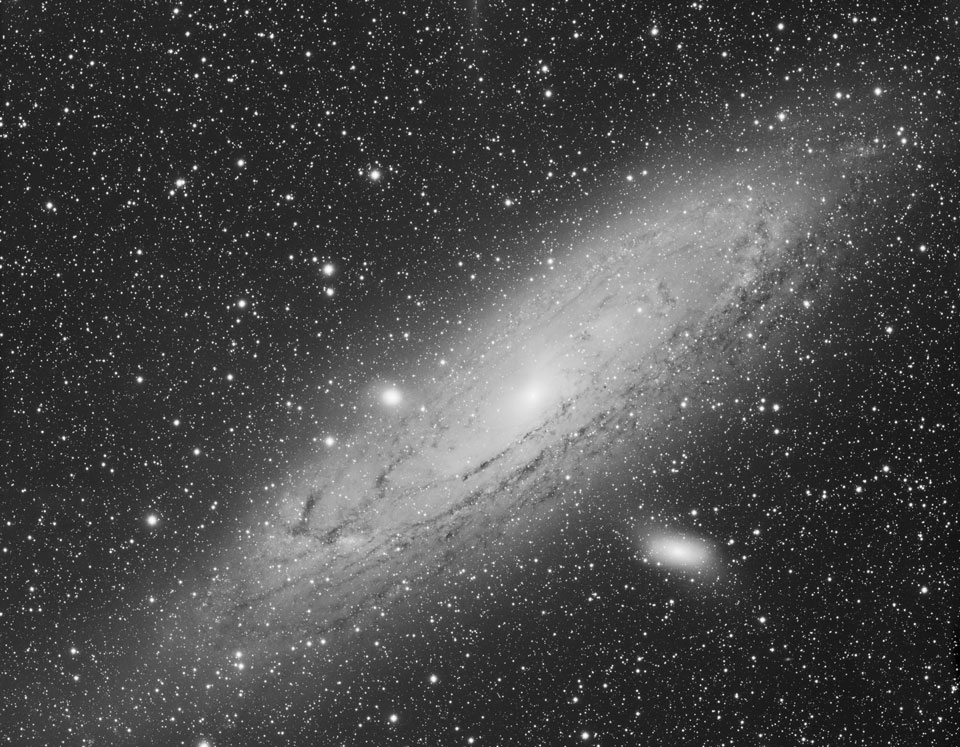
Andromeda Through Gas and Dust
Image Credit & Copyright: Nick Fritz
Text: Keighley Rockcliffe (NASA GSFC, UMBC CSST, CRESST II)

Explanation: Over 1000 years ago, Persian astronomer Abd al-Rahman al-Sufi published humanity’s oldest known record of the Andromeda Galaxy in “The Book of Fixed Stars” (Bodleian Library MS. Marsh 144 p. 167). 800 years later, Andromeda became the 31st entry in Charles Messier’s “Catalogue of Nebulae and Star Clusters“. From “a small cloud” to “nebula” and now known to be our nearest major galaxy, Andromeda has remained a fundamental astronomical object. Today’s image, taken over 202 hours, shows how far we have come in our ability to observe our neighbor. The diffuse red and blue clouds are mostly foreground ionized hydrogen and oxygen well within our Milky Way. Pink-red clouds of hydrogen ionized by the energetic light of young stars trace the galaxy’s dusty spiral arms. M32 and M110 are satellite galaxies pictured orbiting the larger Andromeda. Despite its long history of observation through ancient unaided eyes to modern telescopes, Andromeda still holds countless secrets that astronomers will continue to search for, including how galaxies merge and evolve, as well as the nature of the dark matter that galaxies reside in.

Tomorrow’s picture: a cosmic buckyball

Astronomy Picture of the Day

The Vela Supernova Remnant
Image Credit & Copyright: José Mtanous

Explanation: The explosion is over, but the consequences continue. About twelve thousand years ago, a relatively normal star in the constellation Vela suddenly exploded, creating a strange point of light briefly visible to humans living near the beginning of recorded history. The outer layers of the star crashed into the interstellar medium, driving a shock wave that is still visible today. The featured image, taken piecemeal over 60 hours from the Khomas Region of Namibia, captures some of that filamentary and gigantic shock in visible light, with details highlighted by hydrogen (red) and oxygen (blue) emissions. As gas flies away from the detonated star, it decays and reacts with the interstellar medium, producing light in many different colors and energy bands. Remaining at the center of the Vela Supernova Remnant is a pulsar, a star as dense as nuclear matter that spins around more than ten times in a single second.

Tomorrow’s picture: open space

Astronomy Picture of the Day

Saturn at Night
Image Credit: NASA, JPL-Caltech, Space Science Institute, Mindaugas Macijauskas

Explanation: Telescopic views of Saturn and its beautiful rings often make it the star of star parties. But this stunning view of the outer gas gaint planet’s rings and night side just isn’t possible from telescopes in the vicinity of planet Earth. Peering out from the inner Solar System they can only bring Saturn’s day side into view. In fact, this image of Saturn’s slender sunlit crescent with the planet’s night shadow cast across its broad and complex ring system was captured by the robot spacecraft Cassini. After a seven year long journey from planet Earth, Cassini called Saturn orbit home for 13 years (from 2004 – 2017) before it was directed to dive into the atmosphere of the gas giant on September 15, 2017. This magnificent mosaic is composed of frames recorded by Cassini’s wide-angle camera only two days before its grand final plunge. And Saturn’s night will not be seen again until another spaceship from Earth calls.

Tomorrow’s picture: star debris

Astronomy Picture of the Day

Eagle Nebula Pillars in Infrared from Hubble
Image Credit: NASA, ESA, Hubble, HLA; Processing: Luis Romero Ventura

Explanation: Newborn stars are forming in the Eagle Nebula. They are gravitationally contracting in pillars of dense gas and dust. The intense radiation of these newly-formed bright stars is causing surrounding material to boil away. This image, taken with the Hubble Space Telescope in near infrared light, allows the viewer to see through much of the thick dust that makes the pillars opaque in visible light. The giant structures are light years in length and dubbed informally the Pillars of Creation. Associated with the open star cluster M16, the Eagle Nebula lies about 6,500 light years away. The Eagle Nebula is a satisfying target for small telescopes in a nebula-rich part of the sky toward the split constellation Serpens Cauda (the tail of the snake).

Tomorrow’s picture: open space

Astronomy Picture of the Day

Supermoon Versus Micromoon
Image Credit: Soumyadeep Mukherjee

Explanation: What is so micro about tonight’s blue micromoon? Just after sunset, a full moon will appear slightly smaller and dimmer than usual. The reason is that the Moon’s fully illuminated phase occurs within a short time of apogee – when the Moon is farthest from the Earth in its elliptical orbit. In fact, tonight’s micromoon will be the farthest, smallest, and dimmest Moon this year. But tonight’s micromoon is notable for yet another reason: it is also a blue moon, meaning that it is the second full moon in the same month (moon-th). Pictured here, a supermoon — when the full moon appears near its largest — is compared to a micromoon as photographed from Kolkata, India in May and December of 2021. Although the next micromoon occurs next month, and the next blue moon at the end of 2028, the next blue micromoon will not occur until 2053.

Tomorrow’s picture: eagle stars

Astronomy Picture of the Day

Messier 104
Image Credit: CTIO, NOIRLab, DOE, NSF, AURA;
Image Processing: T. A. Rector (U. Alaska Anchorage), D. de Martin (NSF’s NOIRLab) & M. Zamani (NSF, NOIRLab)

Explanation: A gorgeous spiral galaxy, Messier 104 is famous for its nearly edge-on profile featuring a broad ring of obscuring dust lanes. Seen in silhouette against an extensive central bulge of stars, the swath of cosmic dust lends a broad brimmed hat-like appearance to the galaxy suggesting a more popular moniker, the Sombrero Galaxy. Also known as NGC 4594, the Sombrero galaxy can be seen across the spectrum and is host to a central supermassive black hole. About 50,000 light-years across and 28 million light-years away, M104 is one of the largest galaxies at the southern edge of the Virgo Galaxy Cluster. Still, the spiky foreground stars in this field of view lie well within our own Milky Way. This broad view of the well-known galaxy was processed to reveal M104’s extended halo, as well as a faint tidal stellar stream. It was captured by the Dark Energy Camera (DECam) on the Blanco 4-meter telescope at the Cerro Tololo Inter-American Observatory.

Tomorrow’s picture: moon sizes

Astronomy Picture of the Day

PK 164 +31.1: The Headphone Nebula
Image Credit & Copyright: Bernard Miller
Text: Keighley Rockcliffe (NASA GSFC, UMBC CSST, CRESST II)

Explanation: What is a pair of headphones doing in the sky? Today’s image features the Headphone Nebula, also known as PK 164 +31.1 or Jones-Emberson 1. This planetary nebula, the remnant of a dying Sun-like star, faintly occupies an angular region of the Lynx constellation about 1/5th the diameter of the full moon. The red and blue-ish green colors trace hydrogen and oxygen atoms, respectively, that have been excited and ionized by the nebula’s central white dwarf. The headphone shape, where two lobes of hydrogen puncture the inner region of oxygen, adds this object to a long list of oddly shaped nebulae. The morphology of such strange nebulae hint at the presence of a stellar or planetary companion, which can stir the material flowing out from the dying star. You can listen to Hubble and JWST sonifications of planetary nebulae through your very own headphones!

Tomorrow’s picture: gaze into a Crystal Ball

Astronomy Picture of the Day

NGC 3660 and Burçin’s Galaxy
Image Credit & Copyright: Adam Block, El Sauce Obs.

Explanation: The upper galaxy might be more photogenic, but the lower galaxy is more unusual. The galaxy up top is NGC 3660, a spiral galaxy similar to our own Milky Way galaxy in that it has several bright blue spiral arms and a central bar of stars, dust, and gas. Captured by chance in the featured deep and colorful image, surprisingly, is SN 2026cff, a supernova found just to the right of the central bar. Farther in the distance is the bottom galaxy, known informally as Burçin’s galaxy, but formally cataloged as LEDA 1000714. The center of this galaxy appears to be an old elliptical galaxy, but it is strangely surrounded by not one but two rings of stars. What created Burçin’s galaxy is a mystery and remains a continuing topic of research, but it likely involves the accretion of one or more smaller galaxies.

Tomorrow’s picture: open space

Astronomy Picture of the Day

Thackeray’s Globules
Image Credit & Copyright: John Hayes

Explanation: What are these strange space globs? Situated in rich star fields and glowing hydrogen gas, these opaque clouds of interstellar dust and gas are so large they might be able to form stars. Their home is known as IC 2944, a bright stellar nursery located about 7,600 light years away toward the constellation of the Centaur (Centaurus). The largest of these dark globules, first spotted by A. D. Thackeray in 1950 using a telescope in South Africa, is likely two separate but overlapping clouds, each more than one light-year wide. Along with other data, the featured Hubble palette image from the El Sauce Observatory in Chile, indicates that Thackeray’s globules are fractured and churning as a result of intense ultraviolet radiation from young, hot stars already energizing and heating the bright emission nebula. These and similar dark globules known to be associated with other star forming regions may ultimately be dissipated by their hostile environment — like cosmic lumps of butter in a hot frying pan.

Tomorrow’s picture: different galaxies